

Why You’re Still Not Getting What You Want (Part 1: The Ask Stack)
Relationship advice for myself


I have a confession that probably surprises no one who has listened to our podcast or followed me on Twitter: I kind of hate asking for things directly. Remember that Twitter thread where I solicited advice on initiating sex, and people responded with some variation of “this is literally so easy for women, are you ok?” Remember how my primary kink is sex I didn’t ask for?
Struggling to ask for what you want is not a unique problem. Rejection is terrifying. It feels safer to manage your own needs quietly, hint around your preferences, and hope your partner figures it out. This self-abandonment has a seductive logic: if you never ask, you never get a no. The problem is that shrinking your needs is a reliable path to resentment and a worse relationship. The suppressor gets quietly miserable and their partner never gets the chance to show up. The intimacy that comes from being genuinely known is forfeited.
So why does “just ask directly” fail so often as advice? A few months ago we published a piece called How to Get What You Want from Men: ask for things you want, express gratitude when you get them, send your partner on quests, let him be a hero. Good tactics. I stand by all of it. But tactics are only part of the picture.
I think most advice in this arena underestimates the number of steps involved in requests and the complexity of skills required to navigate them. I call the steps to get what you want the “Ask Stack,” and there are several distinct places it can break down. If you’re not targeting the relevant stage by developing the right skills, you’ll keep getting disappointing results.
Before we get into the framework: the Ask Stack is what I understand intellectually. The internal work is an ongoing practice for me. I’m not writing from the other side of this problem. I’m writing from the middle of it. I think this makes me a more useful guide than someone this comes naturally to, but I may still have blind spots.
This is Part 1: the Ask Stack framework and how to diagnose where yours is breaking. Part 2 covers the taxonomy of ask types and where the two frameworks intersect to produce specific failure modes. Parts 3 and 4 cover the internal work and the full tactical toolkit. Poly readers: Part 5 addresses navigating all of this across a network of relationships.
The Ask Stack
“Getting what you want” breaks down into at least five steps, each with its own failure modes.
Knowing what you want — sometimes you genuinely don’t
Asking for it — the part most people assume is the whole problem
Your partner understanding — they heard you, but missed the point
Your partner acting on it — they understood, but didn’t change
Your partner continuing to act on it — they did it for a while, then stopped
The precondition to all of this is a partner who, upon receiving information about what you want, actually cares, and who is willing to work to improve their relationship skills. The Ask Stack assumes you’ve cleared that bar. Without it, the other steps are largely irrelevant. We’ll call this step zero.
Further, each step has two lanes: skills that belong to you, and skills that belong to your partner. Both lanes have to be functioning for the pipeline to work. None of this means treating the relationship as adversarial. The lanes exist so you can collaborate accurately, not so you can keep score.
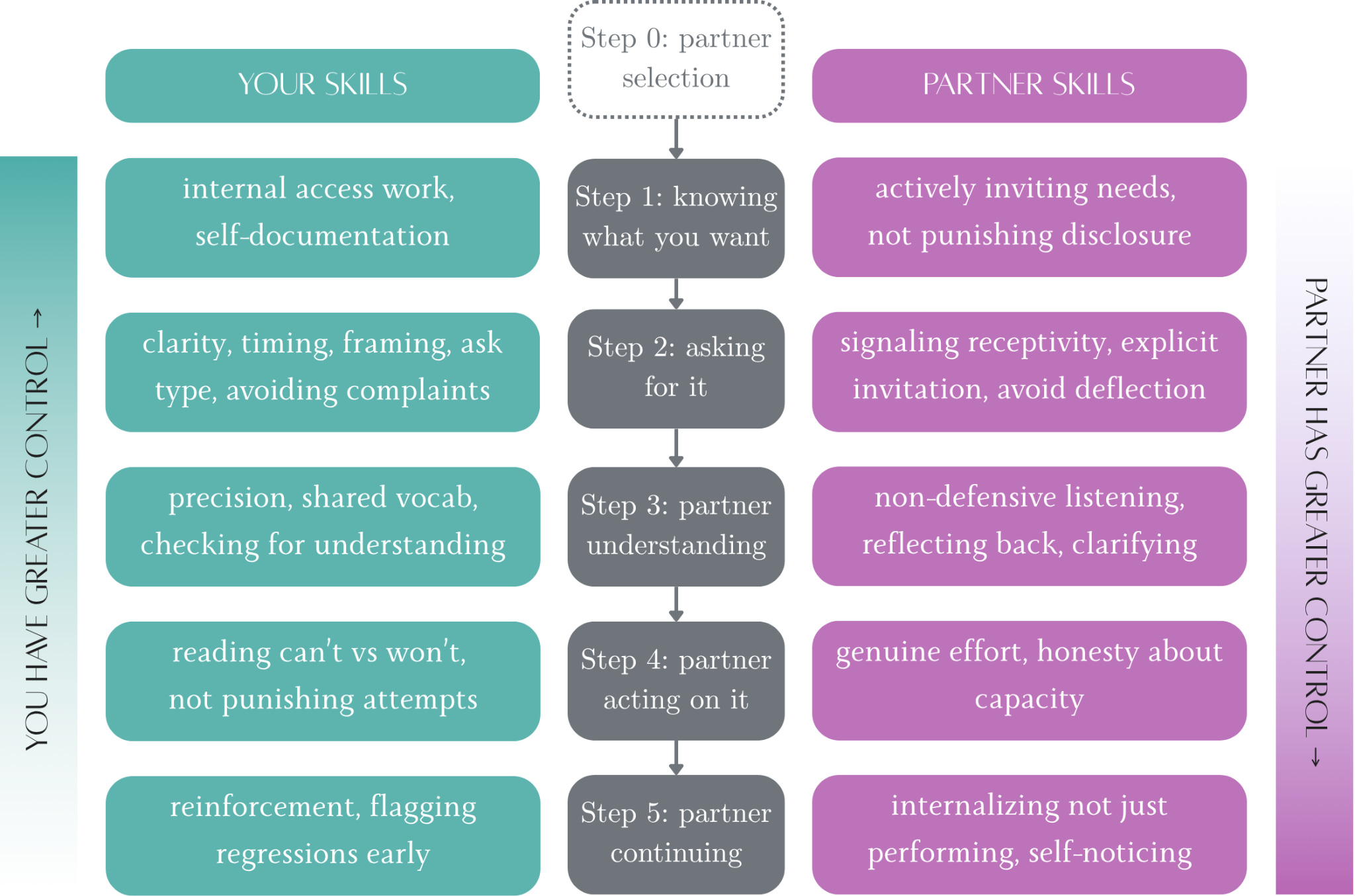
This is the part most communication advice misses entirely. It focuses on your lane (ask more clearly, pick a better moment, use different words) while treating your partner’s lane as a fixed condition. But your partner has real work to do at every stage, and understanding whose lane a failure is living in changes what you do about it.
The other thing worth naming upfront: your control over the pipeline decreases as you move down it. Steps 1 and 2 are almost entirely yours. By step 4, you’re largely in your partner’s hands. That asymmetry matters for how you interpret failure and where you direct your energy.
Step Zero: Partner Selection
Before any of this works, you need a partner who actually gives a fuck about what you want.
“Responsive to your needs” doesn’t mean someone who always gives you what you ask for. It means someone for whom your happiness is genuine information they want and act on. One particularly relevant framework here is Schnarch’s concept of differentiation, which describes the capacity to stay connected to a partner without losing your own sense of self in the process. The short version is that you want a partner secure enough to say no to you. Somewhat paradoxically, knowing your partner will say no to requests that don’t work for them is an essential ingredient to feeling safe making the ask.
I’ve experienced both ends of the spectrum of partner responsiveness to my needs. Most of my partners have actively encouraged me to ask for more, and explicitly told me they want to know what I need. Being on the receiving end of that kind of invitation is genuinely revelatory if you’ve spent years assuming your needs are an inconvenience at best and a dealbreaker at worst.
Contrast that with my time dating an avoidant: the constant low-level vigilance about being too needy, the sense that the wrong ask at the wrong moment might cause him to simply disappear. I became a worse communicator in that relationship, because the environment selected for suppression. My communication and needs weren’t the problem. My partner selection was.
Some needs are genuinely incompatible, and no amount of communication will bridge them. The sooner you figure that out, the better.
Step 1: Knowing what you want
Sometimes the pipeline fails before anything is said. You don’t know what you want. Or more precisely, you know something is wrong but can’t name it clearly enough to ask for it.
Your lane: learning to tell the difference between genuine not-knowing and the kind of not-knowing that’s actually suppression in a trench coat. “I don’t know what I want” is sometimes true. More often, in my experience, it’s “I know but it feels dangerous to know.” The work is sitting with the discomfort long enough to let the actual answer surface, instead of immediately managing it away because the answer is inconvenient or scary or makes you feel needy. Creating self-documentation is useful here. Not because the document is useful later (though it is) but because trying to put a need into a sentence forces you to find out whether you actually have one. Writing helps with thinking and clarifying.
Partner’s lane: making your knowing feel safe. This is wildly underappreciated. A partner who responds to asks with guilt, withdrawal, criticism, or by bringing the ask back up six months later as ammunition isn’t just failing at step 4. They’re degrading your step 1 capacity in real time. You learn to stop knowing things that have historically been punished. The not-knowing is protective. A partner who explicitly says “I want to know what you need, please tell me” is doing something structurally different from one who merely tolerates being asked, and I’ve found the difference can show up in what I can even access about myself.
Step 2: Asking for it
You know what you want. Now it has to leave your mouth in a form your partner can actually receive. This is the step most advice treats as the whole problem.
Your lane: clarity, timing, framing. Not burying the ask inside a complaint. Not hinting and hoping. Not pre-loading the answer with “you never do this, but would you consider,” which is a complaint in question’s clothing. Choosing the right register matters too: sometimes you want a direct ask, sometimes a preemptive share, sometimes a low-stakes bid. Knowing which one you’re going for before you start talking matters more than most people realize (I’ll get into that more in Part 2 in this series).
Partner’s lane: signaling that asking is welcome, and not making it expensive. The explicit invitation (“I want to know what you need, please tell me”) is not just a nice thing to say. It structurally changes what step 2 feels like for someone who has spent years learning that asking is dangerous. The opposite move is just as powerful in the other direction: a partner who meets asks with defensiveness, deflection, or an immediate counter-grievance is training the asker to stop asking, and no amount of skill on the asker’s side fixes that. You can’t out-communicate a partner who has made communication costly.
Step 3: Partner understanding
The ask has been made. Whether it landed is a separate question, which is why this is a separate step.
Your lane: precision, and shared vocabulary. This matters most for what I think of as relational architecture asks, where the same words mean wildly different things to different people. “I want more closeness” can mean five entirely separate things. “I need more space” can too. Define the term before you make the ask, not after the conversation has already gone sideways and you’re trying to recover. Check that what you said is what they heard. “Can you tell me what you think I’m asking for” sounds clinical, but it can help.
Partner’s lane: actually listening, instead of defensively listening. Hearing what was said instead of what they were braced to hear. Asking clarifying questions before mounting a response. Reflecting back. This is the step where the receiver’s anxiety is most likely to corrupt the signal: a partner who is frightened of what you might need will mishear you in the direction of something they can manage. I have been on both sides of this, and the unsettling part is that when you’re the one mishearing, it doesn’t feel like mishearing. It feels like you understood. That’s what makes it so hard to catch in yourself, and so frustrating to point out in someone else.
Step 4: Partner acting on it
This is where your control over the pipeline drops most sharply. Your partner understood. What happens next is mostly in their lane.
Your lane: telling the difference between “they won’t” and “they can’t.” These look identical from the outside and they require completely opposite responses. Won’t is a prioritization problem. Can’t is a capacity problem, and capacity problems don’t respond to better communication. Misreading a can’t as a won’t might be the costliest mistake here, because it tells you the problem is your delivery when the problem is the territory. The other thing in your lane: not punishing imperfect attempts. A partner who tries something new and gets criticism or a flat reaction learns not to try.
Partner’s lane: actual effort. Tolerating the discomfort of doing something unfamiliar. Not letting vague concerns about autonomy (“I don’t want to feel controlled”) quietly convert understanding into inaction. And above all, being honest about which one is true. “I hear you and I’m choosing not to” is a respectable answer. So is “I hear you and I don’t think I can.” What corrodes trust is the third option: repeated promises that quietly fail, with no honest accounting of why. That’s the move that makes the asker stop believing anything.
Step 5: Partner continuing
Change is easier to produce than to sustain. A partner who shifts their behavior for two weeks and then regresses to baseline is a different problem than a partner who never shifted at all, and it requires a different response.
Your lane: reinforcement, and early flagging. Acknowledge the pattern when it’s working. Not effusively, just noticeably. “I really appreciated that” is load-bearing in a way that’s easy to dismiss because it sounds small. It isn’t small; it’s the thing that tells your partner the new behavior is registering, which is most of why people keep doing things. And when reversion starts, flag it early, as information rather than as grievance. The longer you absorb drift in silence, the more accumulated resentment shows up with the eventual conversation, and the harder it becomes for your partner to receive the feedback as a course correction instead of an indictment. I am bad at this. I tend to wait until I’m already quite upset, which is exactly the wrong moment to bring it up, and I have had to train myself to flag things at relationship check-ins before they reach crisis scale.
Partner’s lane: internalizing the pattern instead of just performing it. There’s a real difference between a partner who does the thing because they were asked and a partner who has absorbed why it matters and starts to notice its absence on their own. The second is what step 5 success actually looks like. Self-noticing reversion (catching the drift before being told) is the highest expression of the partner skill at this stage, and it’s also the clearest signal that the change has moved from compliance to integration.
The Ask / Guess / Reveal Culture Problem
Before applying any tactics, it’s worth knowing whether you and your partner are operating from compatible assumptions about whether needs get stated or intuited.
Ask culture: you ask for what you want, no is an acceptable answer, and the ask itself is not an imposition. Guess culture: you don’t ask unless you’re reasonably sure the answer is yes, and asking itself feels like an imposition. Reveal culture is the proactive version: you share something true about yourself before you’re asked, trusting that your partner having an accurate picture of you is good for both of you. My sex doc and my guide to dating me are reveal culture in practice.
The purest expression of guess culture I’ve seen recently was a slide that went viral on Twitter:
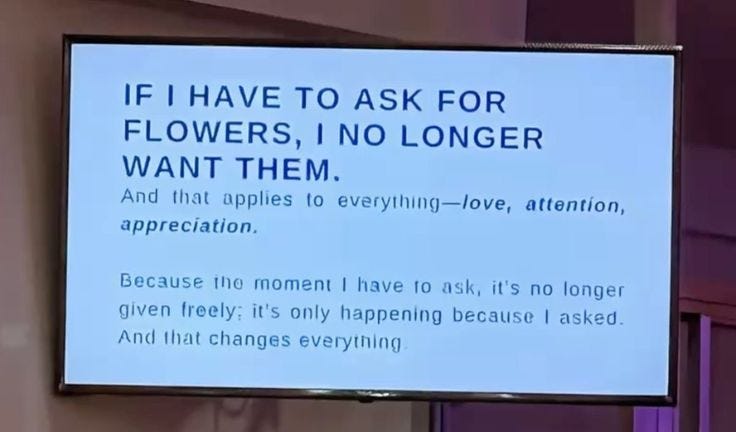
This post accrued over 50,000 likes. A lot of people found it romantic.
Here’s what that position misses: the partner who brings you flowers unprompted almost certainly learned what mattered to you through earlier communication. And if not through that, then they are likely treating you according to generic dating scripts. Scripts can be a reasonable starting place, but they only get you so far.
Philosophically, making someone guess their way to knowing me isn’t actually that romantic in my view. The attunement that looks like mind-reading is downstream of a period of asking, telling, and revealing. You don’t get the magical partner who just knows without first being the person who let them see. The vulnerability isn’t a failure to be transcended. It’s how you get there.
Getting into a compatible communication culture resolves a lot. Understanding your partner’s native culture is how you start.
What This Means for Troubleshooting
Before you move on to Part 2, it’s worth sitting with two questions.
Which step is failing?
Whose lane is the failure living in?
A step 3 failure in your lane calls for clearer communication. A step 3 failure in your partner’s lane calls for something else entirely, and “communicate better” will not fix it, no matter how many times you try.
A common mistake in relationship communication is applying your-lane interventions to partner-lane problems. It keeps you endlessly improving your delivery when the issue is your partner’s receptivity. It’s worth being honest with yourself about which one you’re dealing with.
Part 2 introduces the second framework, the taxonomy of ask types, and shows where the two frameworks intersect to produce failure modes that neither reveals on its own.
Where does your Ask Stack usually break down (step and lane)? I’d love to hear in the comments.
I love that you're writing about this while you're still in it. I think it feels more grounded this way, with notes on which parts are still difficult for you.
Direct communication gets framed like "come on just do it" so often, without acknowledging all the obstacles and incentives working against it. There's a lot that goes into making it actually work so I'm glad you're laying it out!
> It keeps you endlessly improving your delivery when the issue is your partner’s receptivity
Oops, that one's me 🫢
SlutCon was great for helping me unblock "asking for it"! Nowadays I'm finding that my difficulty lies more in "knowing what I want".