

Parallel Poly Is Monogamy-Coded
Here’s why it’s important to introduce your partners to each other


Please note: I’m just a rogue slut with a Substack, not a therapist. Take this as the case for kitchen table poly I’d make for people like me. This isn’t for you if you’re happily somewhere else on the spectrum.
Recently, one of my metamours suggested we pick up our boyfriend from the airport together. He didn’t know I’d be there. He was delighted when he walked through the doors and found us both. Cue the montage: us sitting in airport traffic hoping we’d beat him to the gate, scrambling to position ourselves at the right exit, him walking out looking dapper if a little tired, us burying him in a group hug and kisses, and all of us bouncing off towards my car for the drive home.
That’s the kind of thing that couldn’t have been routed through him without spoiling the surprise. It wouldn’t have been possible in a parallel setup.
This is what kitchen table polyamory produces that parallel poly structurally can’t. And yet the conventional wisdom in most poly spaces says to start with parallel poly and only move toward integration once you’ve built the emotional infrastructure (if at all).
I think this advice is backwards.
What the Data Says
Aella surveyed 23,000 people about their relationships and found a U-shaped satisfaction curve across the monogamy-to-polyamory spectrum. Very monogamous people rate their relationships well. Very poly people rate them even better. The people in the middle consistently trail in last. The middle isn’t a safe harbor. It’s where the costs accumulate with the fewest benefits.
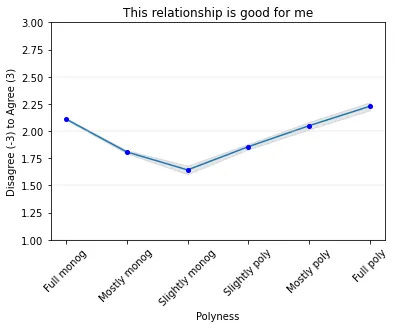
More info on Aella’s dataset and methodology are available at her Substack, Knowingless.
This U-shape relationship may seem surprising, but it’s roughly what evolutionary biology would predict. The best-developed framework here is strategic pluralism: humans didn’t evolve a single mating strategy but a conditional one. Both high-investment pair bonding and lower-investment multiple partnership strategies are evolutionarily viable, depending on environment and individual variation. Monogamy and polyamory aren’t a norm and a deviation. They’re two ends of a bimodal distribution of human mating orientations, both of which work well when you’re running the right one for your hardware. Polyamory isn’t intrinsically harder, it just seems that way if you’re running the wrong operating system.
The messy middle, on this reading, is where orientations collide. Dan Savage coined “tolyamory” for people who aren’t thrilled their partner is poly but are willing to tolerate it. Those partnerships don’t show up at the committed ends of the spectrum. The satisfaction penalty in being slightly monogamous probably isn’t from the structure itself; it’s from the chronic incompatibility the structure is papering over.
The Simplified Poly Spectrum
Three points on the map worth naming:
DADT (Don’t Ask Don’t Tell) sits at the far end, nearest monogamy: partners agree not to disclose or discuss outside relationships at all. Most thoughtful poly people consider it a red flag. I’ll come back to why it’s relevant later.
Parallel poly is what Google recommends if you search “how to start polyamory.” Partners know other relationships exist but have minimal contact with each other. Your boyfriend’s girlfriend is a name you know but a person you’ve never met. Everything routes through the hinge (shared partner). These are usually the “slightly” or “mostly” poly people in Aella’s data.
Kitchen table polyamory (KTP) is where everyone knows each other well enough to sit around the kitchen table together. Metamours are real people in your life, not abstractions managed at a distance. In Aella’s data set, I’d expect that KTP people primarily identify as “full poly.”
There are plenty of other substyles (garden party poly, lap sitting poly, hierarchical vs. non-hierarchical) but that’s not what this piece is about.
The conventional wisdom frames this as a progression: start at parallel, move toward KTP only once you’re ready, or stay put if you’re satisfied. I think it’s a framework that flatters the cautious option and obscures what you’re actually trading away.
The Monogamous Architecture of Parallel Poly
The structure of parallel poly doesn’t get examined enough. It’s not really a departure from monogamous relationship logic. It’s an extension of it.
Monogamy’s core operating assumption: romantic relationships should be kept separate from each other (in series) and held above the broader social fabric of your life. Parallel poly allows multiple simultaneous relationships, but otherwise doesn’t question the separation principle. You’ve expanded the number of compartments without asking whether compartmentalization was the right organizing principle to begin with.
KTP is where the walls actually start coming down. Your romantic world and your social world aren’t separate territories with managed borders; they’re free to merge into one integrated whole. The people who love you can be in the same room. You’ve unlocked new levels of being loved and seen through that integration.
You can be technically polyamorous without very many upgrades to your emotionally monogamous architecture. The “ease in via parallel poly” advice lets you do exactly that. In that sense, parallel poly is the path of least resistance. The catch is that it may not actually be easier to live.
The Psychological Case for Integration
Compartmentalization isn’t just structurally inefficient. It’s psychologically costly.
Take DADT as an illustration. Nobody defends it as emotionally healthy, and the reason is obvious: it demands a permanent partition in your own mind between the rest of your intimate life and your primary partnership. You can’t be fully known. You can’t bring your whole self. The self-monitoring strain isn’t occasional; it’s structural and permanent.
DADT is the logical endpoint of the parallel poly philosophy. If separation is the organizing principle, DADT is just separation taken to its conclusion.
Parallel poly asks you to maintain a milder version of this indefinitely. Your partners’ other relationships stay structurally at a distance. You’re not hiding anything exactly, but you are maintaining separation: managing information asymmetries, representing people who aren’t in the room. The hinge functions as a relay node. Signal degrades in transmission.
The monogamous assumptions parallel poly lets you keep are the same ones that generate anxiety in practice. When your partner’s other relationships are kept at a distance, your brain fills in the blanks. Anxiety thrives in uncertainty, and parallel poly is structurally committed to maintaining it.
KTP strips the partitions out. You can talk directly to metamours without a middleman. You’re also forced into greater honesty, because you can’t get away with inconsistencies across partners when everyone has the option to compare notes directly.
There’s a reason coming out matters even when the reception is hostile: the psychological benefit is intrinsic to integration itself, not contingent on the world receiving you well. Parallel poly is like keeping your partners in separate closets. Kitchen table poly means everyone gets to actually be known.
Personally, parallel poly was where I went to be avoidant and keep my options open. It’s easy to just “try on” different relationships instead of committing, if everyone is kept separate. I’d even go so far as to say I was more likely to attract and select people who were mutually comfortable with avoidance when I was parallel, since the structure filters for it.
Chris Lakin’s friend put it well:
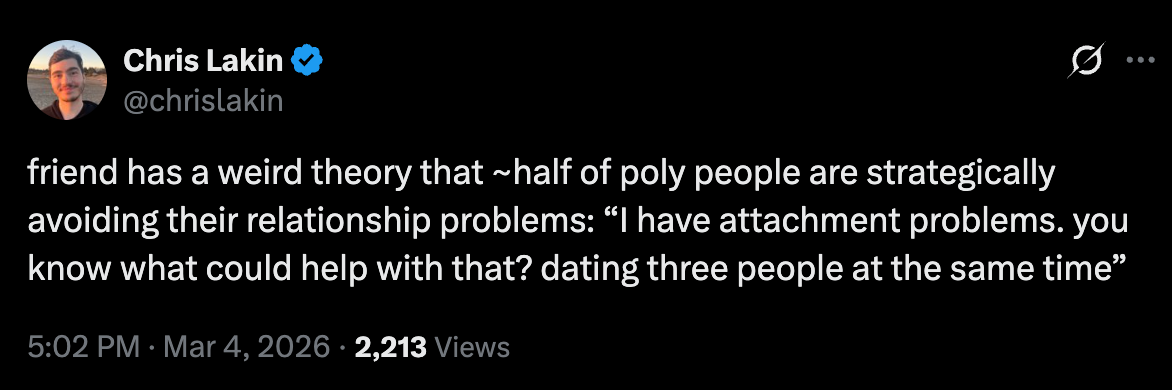
Parallel poly is where you are most likely to see this because it is the structure that most accommodates avoidance. It lets you use distraction to avoid your anxiety, without forcing integration. KTP makes that structurally harder. You’re too visible to everyone for the evasion to hold. Greater integration is practically unavoidable in KTP. And KTP is where I have felt the most secure and honest about what I want.
Integration can go further than dinner parties. Being at a CNC orgy where people you love are conspiring against you, or fucking their other partners right next to you, does something to the nervous system that cognitive reassurance alone doesn’t. You’ve experienced something taboo together, but it was surprisingly wholesome, and normalized by everyone treating it as such. People come away with a reduction in the background hum of jealousy, an embodied trust that no amount of talking it through quite replicates, and a sense of having seen each other in a way that changes things afterward. Some experiences don’t just feel nice in the moment. They rewire you.
The Actual Tradeoffs
The psychological case is compelling on its own. The practical one is even more so.
The standard case for parallel poly is lower drama: fewer moving parts, fewer opportunities for conflict. The implicit assumption is that the only alternative is messy, poorly executed KTP.
But there’s a secret third option: highly functioning KTP. It takes skill to get there, but it opens access to options that parallel poly structurally can’t produce. Even better, I’ve found highly functioning KTP broadly easier than parallel poly.
The hinge bottleneck and burden. In parallel poly, everything routes through one person. Every misunderstanding, every imperfectly relayed piece of information, every conflict between metamours gets mediated by someone emotionally invested in all parties. That’s not low drama. It’s also exhausting to be the person managing it. KTP doesn’t eliminate conflict, but at least it distributes it across people who can actually talk to each other directly. In my own experience, being able to talk directly to a metamour during a difficult situation helped me exit a relationship that wasn’t working far earlier than I would have otherwise, and with the door left open to something better later. Parallel poly could have drawn that out indefinitely and fostered resentment. This access doesn’t always mean you get what you want. But it gives you more information to work with.
The bought-in metamour problem. It’s hard to overstate how important it is to have metamours who are genuinely invested in polyamory. In parallel poly, you’re assessing someone you’ve never met based on a secondhand account from someone who’s emotionally involved with both of you. That’s a bad information environment. KTP lets you just ask and observe them directly. Their willingness to engage in KTP at all is a useful data point about how genuinely bought-in they are.
The compersion ceiling. Hearing about your partner’s lovely date is one thing. Watching your metamour make your partner light up across a dinner table is another. Compersion is richer when it’s embodied. It’s easier to cultivate genuine happiness about your partner’s other relationships when you can see firsthand what those relationships produce. Poly is easier if you know and like your metamours and have clarity that you are on the same team.
The fractured support network. In parallel poly, your partners are islands. In KTP, they’re a network. Having three boyfriends help you move is a logistical nightmare if you have to schedule them to avoid any overlap. On the other hand, it can be truly magical when a KTP network mobilizes in support of a worthy goal. Good luck organizing something like Pandora’s Box in parallel-land.
The counterfactual connection cost. The people you never get to know because they remain abstractions. Some of my closest friends came into my life as metamours. In parallel-land, they’d be names I recognized. The connections you’re missing in parallel poly are invisible by design. You can’t grieve what you never had access to.
The infrastructure trap. Parallel poly feels like a foundation you’re building on. It isn’t. The emotional skills KTP requires only develop by doing KTP. Time spent in parallel poly isn’t time well invested in being ready for KTP. It’s just time that you aren’t fully sitting with your partner’s other relationships, navigating metamour dynamics directly, or letting yourself be fully seen.
None of this means parallel poly is never the right call. Geography makes integration harder. Some people have existing partners with strong parallel preferences who’ve chosen it deliberately and are genuinely aligned. The question isn’t whether parallel poly can work. It’s whether you’re in it by choice or by default.
Also, it’s not a binary. Each connection finds its place along the spectrum. You can be parallel with one partner and KTP with two others. Even if you screen for KTP-openness, there’s no guarantee your specific partners will actually mesh, or on what timeline that will occur.
Parallel poly may be the “price of admission” to certain relationships, and it is completely up to you if that feels worth paying.
The Aesthetic Argument
I’ve made the structural and psychological cases. A third one is harder to formalize: the aesthetic.
KTP done well is simply more beautiful than parallel poly done well.
The specific experiences I’m thinking of don’t translate neatly into arguments. They’re more like: the particular quality of a dinner where you are at the same table as your metamour, so you get to tease your shared partner together. Being cuddled (or spitroasted) by two partners at the same time. The deep warmth and wholesomeness of a group chat where people are coordinating around someone’s birthday gangbang. Waking up in a house full of people you love and finding someone has already made pancakes.
Think about the difference between a party where you know everyone and one where you know some people but they don’t know each other. The first has a texture the second can’t replicate. KTP allows a life where the people who matter to you are increasingly in the first category.
Moving from Parallel to KTP
There’s a qualitative ceiling on what parallel poly can produce. So if you’re in a parallel poly setup and it feels fine, that’s worth examining. Fine is often what capped looks like.
My primary partner saw Aella’s data before he started dating me and decided to go all the way in on poly. I saw it at a time when I was already KTP and decided I was never going back. Having shared data behind the decision makes that commitment easier to hold. Now when I face challenges in my relationships, I don’t make it worse by wondering if KTP is even the right structure. I just deal with the challenge itself.
Here’s what I wish someone had told me before I became poly: the emotional infrastructure KTP requires isn’t something you build in parallel poly and then deploy later. You build it by doing KTP. The evidence-based treatment for anxiety isn’t avoidance; it’s exposure. Keeping your metamours at arm’s length doesn’t reduce the anxiety around integration over time. It preserves it.
I don’t want to sugarcoat the agony that integration can entail. Aella’s account of what she calls Scary Attention Hijacking (the physiological alarm response to a partner being with someone else) is worth reading if you want a vivid picture of what those costs can look like. But the nervous system that gets hijacked is also one that can be rewired.
The best relationship advice is your own lived experience. But you can only collect that data by running experiments. This means designing your relationships intentionally rather than inheriting their structure by default. Start with a coffee. A group chat. One dinner where everybody’s in the same room. I didn’t end up living with two boyfriends overnight, even if it now feels like the most natural thing in the world when they both walk in to wake me up for morning walkies. It was the product of many gradual steps and a lot of explicit check-ins.
You don’t have to leap into full enmeshment, and I also wouldn’t advise that. The point isn’t a polycule where everyone is deeply entangled. It’s one where the connections aren’t artificially capped.
The only way to know what you’re missing is to stop protecting yourself from finding out.
Where are you on this spectrum, and is it by choice?
I really like the case you make for KTP. My goal is to someday do KTP, but, for me at least, it seems like parallel poly is inevitably going to be a stepping stone towards that.
I don't have an abundance of partner selection yet. The people I date like parallel poly. It's a lot simpler in the short term. As those relationships develop I would like to integrate them in some way with my other partners and community and/or get to know their partners, but I'm not quite there with anyone yet.
Maybe someday I'll date an existing polycule, but outside of that it feels really challenging to setup KTP without having lots and lots of people that desperately want to date me.
I guess this is a simplified breakdown; I would posit that labeling everything where communication happens between metamores as KTP is oversimplified?
I would argue that if there is a spectrum between garden-party Poly to KTP to Lap Sitting Poly, there are a few missing colors in that spectrum? Also a dimension.
The missing dimension is cohabitation; there is very definitely a thing where a core polycule cohabitates and the members have satellites that don’t cohabitate. At the other end of that dimension is solo poly people, who very definitely do not want to cohabitate.
I’m more familiar with a definition of KTP where that describes the cohabitating core polycule— it’s not just any kitchen table, it’s the kitchen table at the home you share.
So for example one of my SOs is basically solo poly, and for the most part I would say that I have a ‘garden party’ with most of the partners of hers, but am kind of her default +1. At some point I became her longest current relationship, so I’ve met most but not everyone else she’s dated in the years we have been together.
My other partner cohabs with one of her partners; when I visit her sometimes we hang out with her cohabiting partner and this past Xmas I actually spent with her and my meta at his family Christmas. So that would be KTP by your definition, but also doesn’t feel KTP because of the inherent power hierarchy that comes from them cohabitating and me not. I guess in my head KTP implies hierarchical equality, whereas in this situation I feel more like a very welcome guest, or maybe a better analogy is like for her I am direct family but for him (the meta) I am extended family?
For myself, beyond these two partners when I date there is a threshold, so a new person gets introduced to my SOs if I’ve ‘caught feelings’ essentially (I am kinky so I have like play partners and sometimes swing, so.. yeah not every connection is relationship oriented?)
In any case, I agree that integration is good, but also I think it’s more complicated based on the types of non-monogamy/poly that are practiced. Another complication is just personalities; not everybody is going to gel as a social unit. My two SOs get along fine, but would not like hang out independent of me; they are very different people, so actually having all three of us together for me is an exercise in making sure I am not third wheeling either of them.
Which brings up kind of a third dimension, which I think maybe is less a part of your practice of poly; namely distance. My solo poly partner is an hour’s drive away while my other partner is a plane flight away. So opportunity to mix/mingle is also a dimension; my LDR partner is more online and I communicate with her much more, while my localish solo poly partner is very much NOT online.
Which is to say: integration is good, but the degree to which integration is even possible is dependent on a number of factors.